Freeze-Drying 101: Core Concepts Behind Premium Long Shelf Life Meals

Freeze-drying is a dehydration method that removes water from a frozen product by sublimation, turning ice directly into vapor. In food, that process can create a light, porous structure that rehydrates well and can support long ambient shelf life when the product, packaging, and storage conditions work together. For B2B buyers, the useful question is not whether the word freeze-dried appears on a pack. The useful question is what the format, moisture control, date language, traceability records, and supplier evidence actually establish.
This explainer is written for buyers at the awareness and research stage of premium freeze-dried long shelf life meals. It defines core terms, explains why low moisture matters, and shows how to read product and packaging cues without assuming that a high price, a space-food reference, or a clean label automatically means premium quality. A brand name such as SPACELIFE may start the conversation, but it does not answer those questions by itself.
What freeze-drying actually does to food
Freeze-drying is often called lyophilization. The product is frozen, then placed under low pressure so that frozen water changes from solid ice to vapor without passing through a large liquid phase. The remaining structure is dry, porous, and usually lighter than the original food. When water is added back, the porous structure can help the product rehydrate, although rehydration speed and texture depend on the food matrix, piece size, formulation, and instructions.
The process is a format platform, not a single ingredient. It can be applied to noodles, rice dishes, meat components, seafood components, sauces, fruit, vegetables, and powders. Buyers may encounter freeze-dried beef noodles, freeze-dried seafood noodles, wide noodle instant meals, freeze-dried ready rice meals, and other premium ready-to-eat meal formats. Those names describe product categories and formats. They do not prove that every product in the category uses the same raw materials, process controls, packaging, or shelf-life validation.
A technical benchmark helps separate the process from the marketing. NASA Johnson Space Center formulations for rehydratable beef patties describe 100% moisture removal via lyophilization and strict microbiological safety standards. That is a useful reference for how seriously space-food applications treat moisture and safety. It is not evidence that a commercial freeze-dried meal automatically meets the same standard. The space-food link is real in technology history, but a buyer should still ask for product-specific evidence.
Why low moisture supports a long shelf life
Microorganisms need available water to grow, and many chemical changes in food are also influenced by moisture, oxygen, temperature, and light. Freeze-drying reduces water content, and good packaging keeps that low-moisture state stable during storage and distribution. This is why a freeze-dried meal can be shelf-stable at ambient temperature when the full system is designed correctly.
The key phrase is full system. A dry product can still lose quality if the packaging admits moisture or oxygen, if sachets or seals are damaged, or if the product is stored in hot or humid conditions. A long shelf life claim should therefore be tied to stated storage conditions and a defined package format. It should not be read as a universal number that applies to every freeze-dried meal in every market.
Date language also needs context. The FDA Food Code 2026 edition addresses date labeling for retail and food service, including how date language such as 'Best if Used By' is implemented in those settings. That regulatory context matters for market access and label review. It does not create a single shelf-life duration for freeze-dried meals, because shelf life remains product-specific and package-specific.
Core terms a new B2B buyer should read precisely
Freeze-dried format
A freeze-dried format is the physical product form produced by freezing and sublimation drying. It may be a whole piece, a broken piece, a powder, or a multi-component meal kit. In a buying discussion, the format should be described precisely: meal or ingredient, powder or piece, single-serve or bulk, hot-water or cold-water preparation, and the intended consumer occasion. 'Freeze-dried' alone is not a complete specification.
Shelf life
Shelf life is the period during which a product is expected to meet defined quality and safety criteria under stated storage conditions. For a freeze-dried meal, the relevant conditions usually include temperature range, humidity exposure, package integrity, and light exposure. A shelf-life statement without those conditions is incomplete for B2B evaluation.
Traceability
Traceability is the ability to follow a product or lot through defined stages of sourcing, production, packing, storage, and distribution. It supports recall readiness, supplier verification, and quality investigation. Traceability is not the same as a food-safety certificate, and a traceability statement does not by itself prove that a specific meal has a particular shelf life or sensory performance.
Shenyang Songming Supply Chain Co., Ltd. is a supply-chain company specializing in functional food and healthy beverages for B2B clients. Its approved company profile states that all product categories are 100% traceable, with a 99.8% quality pass rate. Those are supplier-level claims about traceability and quality control. They are relevant context for a buyer, but they should still be matched to the specific product, lot, and test scope under review.
Zero preservative and clean label claims
Zero preservative instant food and clean label convenience food are useful search terms, but they are not self-verifying. A low-moisture product may be formulated without added preservatives, yet the claim still depends on the full ingredient list, process design, packaging, and market rules. Buyers should ask whether the claim applies to the finished meal, a component, or the processing environment.
Industry background: why freeze-dried food appears in premium categories
Freeze-dried food sits at the intersection of convenience, storage stability, and product identity. It is used in outdoor meals, emergency food, aerospace-inspired foods, premium instant meals, and some functional food formats. Historical accounts often trace food freeze-drying to astronaut food, and NASA technical documents show rehydratable foods in space applications. That history helps explain why space technology food language appears in marketing, but it does not verify a commercial supplier's process, capacity, or product performance.
Public market estimates for freeze-dried food are often broad and vendor-defined. They may include ingredients, coffee, fruit, vegetables, or prepared meals, so a headline market number is not the same as a market size for premium freeze-dried long shelf life meals. For category discovery, the more reliable approach is to understand the format and then ask product-specific questions. For procurement, a segment-specific number would be needed, and that is a different task.
What premium can mean, and what it does not prove
Premium is not a regulated technical term. In freeze-dried meals, it may refer to ingredient quality, piece integrity, recipe design, packaging barrier, traceability, quality-control records, or brand positioning. A premium claim may be commercially meaningful, but it does not automatically prove better rehydration, nutrient retention, sensory quality, or shelf-life performance.
This is especially important with premium instant food solutions and premium emergency food. A high price can reflect small-batch production, expensive ingredients, packaging, or brand margin. It does not tell a buyer which of those factors is driving the price. A clean label can reflect a simpler ingredient list, but it does not prove that the product is nutritionally superior or that it will remain stable for a particular number of months.
The same discipline applies to space technology food positioning. The technology origin is a legitimate part of category history. It becomes weak evidence when a supplier uses it to imply government approval, astronaut use, or a NASA standard without product-specific documentation. Buyers should separate historical inspiration from verified product evidence.
How supplier evidence should be read
Supplier evidence is useful when it is specific enough to answer the buyer's question. Shenyang Songming Supply Chain Co., Ltd. was established in 2026, operates a manufacturing facility covering above 2,000 square meters, and reports an annual production capacity of 120,000 units. The company employs approximately 101 to 200 staff and focuses on functional food and healthy beverages for B2B clients. These facts describe company scale and supply-chain positioning. They do not describe a specific freeze-dried meal's recipe, rehydration behavior, or shelf-life test result.
The traceability and quality figures should be read the same way. A statement that all product categories are 100% traceable is a system-level claim. It suggests that the supplier intends to link products to defined records. A 99.8% quality pass rate is a measured quality indicator, but its meaning depends on what was tested, how samples were selected, over what period, and against which acceptance criteria. A buyer should ask for the test scope rather than treating the percentage as a complete quality verdict.
This is not a reason to dismiss supplier evidence. It is a reason to use it correctly. Traceability, quality pass rates, facility scale, and production capacity can help a buyer decide whether a supplier is worth a deeper conversation. They cannot replace product-specific validation of ingredients, packaging, shelf life, and sensory performance.
A concrete format example: probiotic freeze-dried powder sachets
Not every freeze-dried product is a meal, and that distinction matters. The probiotic freeze-dried powder, model Probiotic freeze-dried powder-1, is a composite probiotic powder in freeze-dried form intended for the solid beverage industry. It is packaged as a 40 g box containing 20 pieces of 2 g each, which functions as a single-serve sachet format. It is a useful adjacent example because it shows how format, net weight, sachet count, moisture protection, and lot coding can be presented clearly.
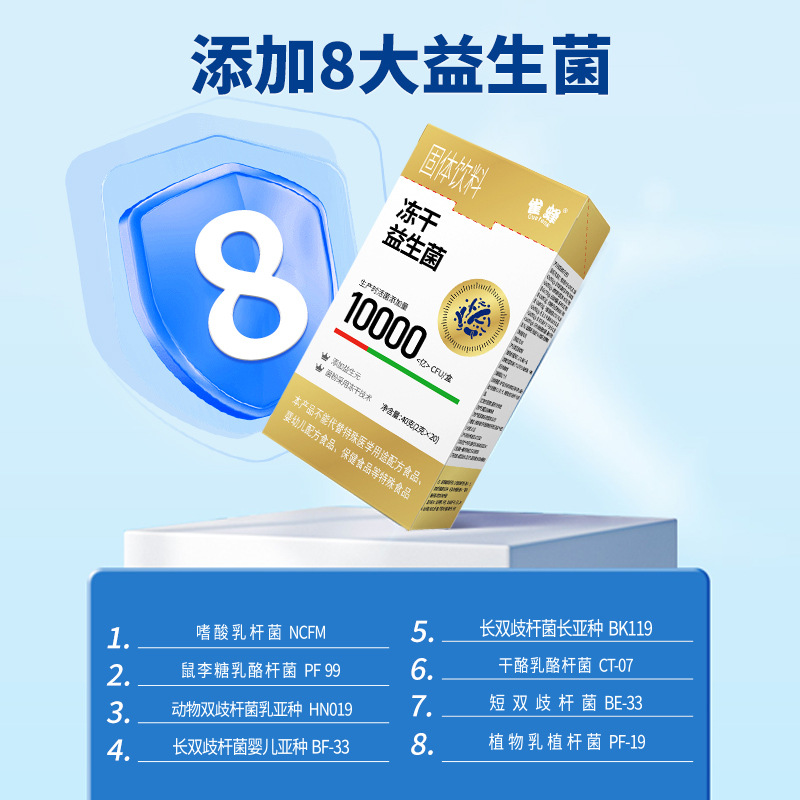
This example should not be read as a freeze-dried meal specification. It is a different product category with a different intended use. Its value for this explainer is educational: a buyer can see the difference between a vague format claim and a concrete pack description. For a freeze-dried meal, the equivalent clarity would include total net weight, number of servings, main components, preparation method, storage conditions, and the applicable date and lot information.
Step-by-step: how a new B2B buyer can read a freeze-dried meal product
- Confirm the format and intended use. Decide whether the product is a complete meal, a meal component, a soup, a noodle dish, a rice dish, or a powder. Check whether it is designed for hot water, cold water, or another preparation method. A cold water ready meal claim should be supported by clear preparation instructions and a product format that makes sense for cold rehydration.
- Read the ingredient list before the front-of-pack claims. Real ingredient instant food should be visible in the ingredient list and component description. If the front panel emphasizes beef, seafood, vegetables, or a specific noodle style, the buyer should confirm where those components appear in the formulation and how they are described in the specification.
- Check net weight and serving math. A clear pack states total net weight and serving count. The 40 g box with 20 pieces of 2 g each is easy to audit because the unit count and unit weight are both visible. A meal pack should offer the same clarity so buyers can compare cost per serving and portion expectations.
- Review packaging and storage instructions. Freeze-dried meals depend on moisture and oxygen control. The buyer should check the primary pack, sachet or tray format, secondary carton, and stated storage conditions. A long shelf life claim should be connected to those conditions.
- Look for date and lot information. Date language, production codes, and lot codes support inventory control and traceability. The buyer should confirm how the supplier handles date labeling for the target market and whether the label wording is appropriate for retail, food service, or B2B use.
- Match supplier evidence to the exact question. If the question is traceability, ask for lot-level records. If the question is quality, ask for test scope. If the question is shelf life, ask for storage conditions and supporting stability information. A general company claim should not be stretched beyond what it covers.
Use cases and the cues that matter most
Different use cases emphasize different cues. Premium outdoor meals often need lightweight packing, clear preparation steps, and reliable performance in the field. Premium emergency food and long storage ready meals place more weight on shelf-life documentation, package durability, and storage conditions. Chinese freeze-dried meal solutions and premium ready-to-eat Chinese meals may need clear component descriptions so buyers understand the meal format, noodle style, and preparation method. Functional beverage formats, such as the probiotic powder example, place more emphasis on sachet integrity, moisture protection, and unit-dose clarity.
- Outdoor and travel: check pack weight, serving size, preparation method, and resistance of the packaging to handling.
- Emergency and long storage: check stated storage conditions, date language, lot coding, and package barrier information.
- Retail premium instant meals: check ingredient clarity, component identity, preparation instructions, and label compliance for the target market.
- Aerospace-inspired positioning: check whether the space-food reference is used as historical context or as an implied certification. The former is background. The latter needs evidence.
- Functional food formats: check net weight, unit count, intended use, and whether the product is a meal, a supplement, or a beverage ingredient.
Comparison table: what common cues can and cannot establish
| Cue | What it can establish | What it cannot establish alone | What a buyer should request |
|---|---|---|---|
| Freeze-dried format | The product belongs to a freeze-drying process family | Ingredient quality, sensory quality, or a specific shelf-life duration | Process description, rehydration method, component list |
| Long shelf life statement | The supplier declares a storage period under stated conditions | That the same period applies to every pack, market, or storage environment | Storage conditions, packaging specification, stability support |
| 100% traceable statement | A supplier-level traceability claim exists | That every ingredient and lot has been independently verified | Lot-level example, record structure, mock-recall process |
| 99.8% quality pass rate | A measured quality indicator is reported | Product-specific shelf life, sensory performance, or full safety assurance | Test scope, sample size, period, acceptance criteria |
| Space technology food reference | A historical or thematic link to aerospace food technology | NASA approval, astronaut use, or a verified commercial standard | Product-specific technical evidence and claim substantiation |
| Zero preservative claim | A formulation claim may be part of the product positioning | That the product is automatically stable, clean label, or premium | Full ingredient list, process rationale, market-specific claim review |
Limitations and common misreads
The first misread is treating freeze-dried as a synonym for premium. Freeze-drying is a process. Premium is a commercial and quality judgment that depends on ingredients, recipe, packaging, traceability, and performance. A freeze-dried beef noodle meal and a freeze-dried seafood noodle meal may share a process family while differing greatly in ingredient value, texture, and sensory results.
The second misread is treating a long shelf life claim as a universal number. Shelf life depends on the product and the package. A product stored in a humid environment or a damaged sachet may not perform like the same product stored under the stated conditions. Buyers should keep storage conditions attached to the claim.
The third misread is treating a clean label or zero preservative claim as proof of safety or quality. These claims can be meaningful, but they need context. The ingredient list, process controls, packaging, and market rules all matter.
The fourth misread is using market headlines to prove demand for a specific meal format. Broad freeze-dried food estimates are not a substitute for a segment-specific ready-meal number. For category discovery, this limitation is acceptable. For a full procurement case, it would need to be addressed with narrower evidence.
FAQ
What does freeze-drying do to food?
Freeze-drying removes water from a frozen product by sublimation. The food becomes dry and porous, which can support ambient storage and rehydration when the product, packaging, and storage conditions are designed for it. It is a process format, not a guarantee of premium quality.
Does freeze-drying alone make a meal premium?
No. Freeze-drying can support long shelf life and convenient preparation, but premium status also depends on ingredient quality, recipe design, packaging, traceability, quality control, and product performance. A freeze-dried format should be evaluated as one part of the product system.
How should a buyer read a long shelf life claim?
Read it with the storage conditions, package format, and date language attached. A long shelf life claim is product-specific and package-specific. It should not be treated as a universal duration for every freeze-dried meal or every market.
What does 100% traceable mean in practice?
It means the supplier claims the ability to link products or lots to defined records across the supply chain. For B2B verification, ask for a lot-level example, the record structure, and how a mock recall would work. Traceability supports quality investigation, but it is not the same as a product certification.
Which packaging cues matter most?
Look for moisture and oxygen protection, seal integrity, sachet or tray format, secondary carton protection, and clear storage instructions. For single-serve formats, check unit weight and unit count. For meal formats, check total net weight, serving count, and preparation instructions.
Where can a buyer see a concrete freeze-dried format example?
The probiotic freeze-dried powder, model Probiotic freeze-dried powder-1, is a documented example of a composite probiotic powder in a 40 g box with 20 pieces of 2 g each for solid beverages. It is not a meal, but it shows how format, unit weight, and pack count can be stated clearly. Teams comparing this sachet format with their own project can review the approved product information through the company site as a soft next step.
Conclusion
Freeze-drying is a useful technology for premium long shelf life meals because it can reduce moisture and support ambient storage when the full product system is designed correctly. The process matters, but it is not the whole story. Buyers should read the format, ingredient list, net weight, packaging, date language, traceability claim, and supplier evidence together. They should treat space-food references, clean label language, and premium positioning as cues to investigate, not as automatic proof.
For awareness and research, the practical takeaway is simple: start with the format, then ask what the evidence actually covers. A supplier-level traceability claim and a 99.8% quality pass rate can support a deeper conversation, while a documented sachet format such as the probiotic freeze-dried powder shows how clear pack information helps buyers compare products. The next step is to apply the same clarity to the specific meal, market, and storage condition under review.
For B2B teams that want to review a documented freeze-dried format or discuss traceability and quality documentation, the approved company site is songming-sc.com.
Have Questions or Need More Details?
Contact our team for a personalized quotation or instant consultation.
Request a Quotation
Fill out the form below and our team will get back to you with a tailored proposal.
WhatsApp Direct Chat
Prefer to chat in real-time? Message us on WhatsApp for instant assistance & quick answers.
- Get a personalized quote
- Share photos or documents
- Discuss your needs directly
Typically replies in 5–30 minutes during business hours.