Freeze-Dried vs. Microencapsulated Probiotic Powder: Which Protects Long Shelf Life Better?
For a solid beverage manufacturer, the shelf-life decision is not "which powder is better in general" — it is which powder still performs after a year inside a sealed sachet. Freeze-dried probiotic powder and microencapsulated probiotic powder are usually presented as two competing answers to that question. They are not competing answers. They operate at different layers of the same process, and in commercial formulas both are often used together.
Freeze-drying, or lyophilization, is a drying technology: water is removed from a frozen material under low pressure, leaving a low-moisture, porous powder that disperses when reconstituted. Microencapsulation is a protection technology: the cell is embedded in, or coated with, a matrix that acts as a physical barrier between the cell and its surroundings.
The practical question for a long-shelf-life solid beverage is therefore narrower than it first appears — does your formula, packaging and distribution route need the drying layer alone, or does it also need the protection layer? This article gives the decision framework, the compliance and capability checks behind it, and the honest limits of both routes.
What "Better" Has to Mean Before You Compare Anything
Buyers ask which option "works better" for a long shelf life, but the phrase hides at least four different endpoints:
- Viability at the end of shelf life — the state of the cells when the consumer opens the pack, not when the batch leaves the factory.
- Performance in the finished drink — dispersion speed in cold or hot water, sediment, and whether the powder disturbs the taste of the beverage base.
- Label and claim simplicity — how much the protection system adds to the ingredient statement, and whether that fits a clean-label positioning.
- Cost per finished unit — including any extra processing step, extra testing and a higher-barrier packaging film.
A single powder can win on one of these and lose on another. A formulation that reaches its viability target with a heavier protective coating may add an ingredient the brand team does not want on the label; a lean freeze-dried powder may need a better film and a drier warehouse to reach the same endpoint.
The failure modes are consistent across solid beverage formats — sachets, stick packs, 40 g boxes and bulk drums: moisture migration inside a composite powder, oxygen passing through the packaging film, heat during transport and storage, and, in acidified drink mixes, the low pH of the beverage once it is reconstituted. Which failure mode you are actually buying protection against is what decides which technology you need.
Where Freeze-Drying Earned Its Reputation — and Where the Data Stops
Freeze-drying, also called lyophilization, is a dehydration technique that was first used by the food industry to process astronaut food. NASA's rehydratable beef patties, for example, are formulated with 100% moisture removal via lyophilization and must meet strict microbiological safety standards (NASA Johnson Space Center, 2024). The link between freeze-dried food and long storage life is not a marketing invention — it comes from a supply requirement in which the food had to remain safe and edible across a mission.
The commercial market is large but unevenly measured. Grand View Research valued the global freeze-dried food market at USD 36.23 billion in 2021 and projected USD 69.83 billion by 2030, while Market Research Future estimated the global market at USD 4.74 billion in 2025. Those two figures are not comparable: vendors count different product scopes, and freeze-dried coffee, ingredients and finished meals are not always grouped together. Any buyer using a market number in a business case should check the definition before relying on it.
More important for procurement is what the data does not cover. There is no verified published market sizing for the freeze-dried probiotic powder segment specifically, and no verified SKU-level specification data across the category. In practice, that means the freeze-dried versus microencapsulated decision cannot be settled by a market report. It is settled by a specification, a sample and stability data.
The Two Technologies Sit at Different Layers of the Process
Freeze-drying answers the question "how do we remove the water without cooking the cells?" The material is frozen and the water is removed under low pressure, so the cell is not exposed to the temperatures used in conventional drying. The result is a low-moisture powder with a porous structure that disperses quickly in water.
Microencapsulation answers a different question: "how do we keep the environment away from the cell?" A probiotic cell can be embedded in, or coated with, a matrix. Polysaccharide systems such as alginate and modified starches, protein-based systems and lipid systems are all discussed in food and supplement formulation literature. The coating acts as a barrier, which matters when the cell has to survive a low-pH drink, a tablet-compression step, or a long and warm distribution chain.
Because they answer different questions, the two are not mutually exclusive. A common approach is to freeze-dry first and then apply an encapsulation layer, or to encapsulate during the drying process itself. The real decision is not "freeze-dried or microencapsulated" but "how many protection layers does this formula require, and what does each layer cost in process steps, label space and testing?"
That framing matters for solid beverage makers in particular, because a solid beverage is usually a composite powder: the probiotic is one ingredient among sweeteners, acids, flavours, minerals and carriers. Each additional ingredient is another opportunity for moisture migration or interaction inside the sachet.
How a Supplier Builds This Into a Solid Beverage Program
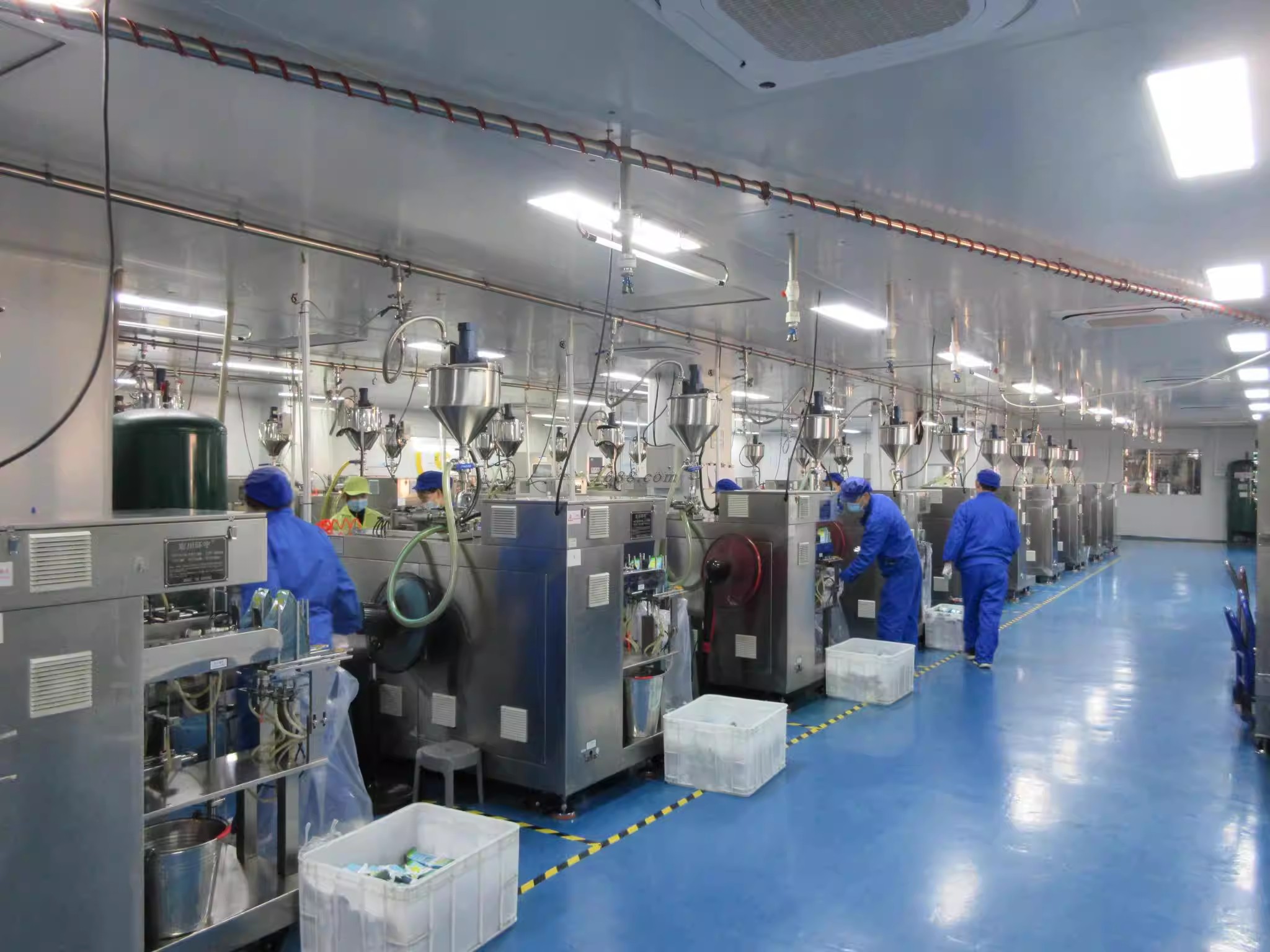
The reference freeze-dried option in this comparison, Probiotic freeze-dried powder-1, is a composite powder supplied in a freeze-dried form in a 40 g box under the SPACELIFE brand, and it is supplied through Shenyang Songming Supply Chain Co., Ltd. — a supply chain company founded in 2026 that specialises in the functional food and healthy beverage sector for B-end clients.
Three capability facts are directly relevant to the freeze-dried versus microencapsulated decision:
- Formulation and R&D depth. The company runs a 25-engineer R&D team, product selection is overseen by a PhD-led team, and flavour profiles are curated by a panel of professors. In a category where the powder has to work inside a composite formula, formulation depth is the capability that decides whether an extra protection layer is necessary at all.
- Process control and traceability. All product categories are 100% traceable, with a 99.8% quality pass rate. For probiotic powders, traceability is the difference between a sample result and a production guarantee — the buyer needs to know that the batch which passed the stability test is the batch being shipped.
- Capacity and format flexibility. The facility covers above 2,000 square meters, employs 101–200 people and produces an annual output of 120,000 units across five core categories: peptide-infused coffee, functional foods, prune juice drinks, meal replacement powders and health supplements. Several of those categories use the same powder handling and filling logic as a probiotic drink mix.
On the commercial side, two figures matter for a first order. Small-batch trial orders start from 30 units, which lets a formulation be tested before a full production run is committed, and 51%–60% of output is exported, so export documentation and destination-market requirements are a routine part of the workflow rather than an exception.
Supply continuity is the other half of the decision. The company reports a 98% on-time order delivery rate and a 30% improvement in cargo turnover efficiency from its free-trade-zone location, and it operates a supply network covering East Asia, North America, the Middle East and Western Europe, with a distribution mix of 30% Japan, 30% US, 20% Saudi Arabia and 20% Germany. For a long-shelf-life product, being able to hold and rotate stock in the destination region is often more valuable to the buyer than a marginal difference in powder performance.
A Step-by-Step Framework for Choosing Between the Two Routes
- Fix the endpoint first. Write down the target: cell status at the end of the declared shelf life, in the actual pack format, at the actual storage temperature. Without this, neither technology can be evaluated.
- Decide whether the drying step is the only barrier you are buying. If the finished beverage is a dry-mixed, neutral product with a high-barrier film and a temperate distribution chain, a freeze-dried powder may meet the target on its own.
- Test whether the formula adds a second stress. An acidified drink mix, a mineral-loaded blend or a highly hygroscopic carrier raises the protection requirement — this is where an encapsulation layer earns its place.
- Check ingredient fusion in the composite powder. The probiotic is not alone in the sachet. Moisture transfer between ingredients, particle-size differences and segregation during filling all affect real shelf life, and they are properties of the blend, not of the probiotic powder alone.
- Match the packaging to the protection level. A more protective powder inside a poor film is not protected. Film choice, headspace and sealing parameters should be decided together with the powder choice.
- Validate on the finished format. Dispersion in cold and hot water, taste in the final sweetener-and-acid system, and cell status at the end of the intended shelf life — tested in the sachet or stick pack, not in a laboratory jar.
- Verify the supplier's process control. Ask for release criteria, batch records and traceability for both the drying step and any coating step, and confirm whether the coating is done in-house or by a qualified partner.
Use Cases: Where Each Route Fits Best
Freeze-dried powder as the primary route generally fits solid beverage programs where the drink mix is neutral to mildly acidic, the packaging is a high-barrier sachet or stick pack, and the brand wants a short ingredient statement. Typical fits include meal replacement powders, functional coffee mixes and clean-label drink mixes aimed at outdoor, travel and emergency-use buyers, where the priority is a powder that rehydrates fully and tastes like food rather than like a supplement. This is also the route behind premium freeze-dried long shelf life meal programs, where zero-preservative, clean-label positioning depends on the drying step rather than on added chemistry.
Microencapsulated powder as the primary route generally fits programs with a harder environment: acidified drink mixes, blends with reactive minerals, products that will sit in warm climates, and formats where the powder is compressed or otherwise mechanically stressed. The trade-off is an additional process step, additional testing and a longer ingredient statement.
A combined route — freeze-dried and then encapsulated — is worth evaluating when the target shelf life, the distribution climate and the label requirement cannot all be met by one layer. It is generally the most expensive of the three options per unit, and it should be justified by a stability result rather than by a preference for more technology.
Comparison Table: Freeze-Dried vs. Microencapsulated Probiotic Powder
| Decision dimension | Freeze-Dried Probiotic Powder | Microencapsulated Probiotic Powder |
|---|---|---|
| Primary function | Drying step: water is removed from the frozen material under low pressure | Protection step: the cell is embedded in, or coated with, a matrix |
| Position in the process | Can be the final powder form delivered to the filling line | Applied during or after drying; can be layered on top of freeze-dried powder |
| Main protection logic | Low moisture content limits water-driven degradation | A physical barrier separates the cell from acid, oxygen and heat |
| Effect on the ingredient statement | Adds nothing beyond the probiotic itself | Adds the coating material or materials to the label |
| Process steps the buyer must qualify | Fewer unit operations to qualify and control | One additional step to qualify, control and test |
| Dispersion in a solid beverage | Porous structure typically rehydrates quickly | Depends on the coating system and its loading level |
| Best-fit applications | Neutral to mildly acidic drink mixes, meal replacement powders, clean-label formats | Acidified mixes, mineral-loaded blends, warm-climate distribution, compression formats |
| Verification evidence to request | Stability data across the declared shelf life; dispersion and taste test in the final pack | All of the above, plus coating-material documentation and coating-step release criteria |
| Can the two be combined? | Yes. Microencapsulation can be applied on top of a freeze-dried powder, and freeze-drying can follow an encapsulation step. | |
| Cost profile | No additional coating materials or coating step | Generally a higher per-unit cost because of the extra step, materials and testing |
The table compares the two technologies at the process level. Neither column implies a numeric viable-cell guarantee; those must be confirmed per SKU from a supplier's stability data.
Frequently Asked Questions
1. What compliance and labeling points should a buyer verify first when choosing between the two powders for a long-life solid beverage?
The regulatory layer applies to the finished solid beverage, not to the drying technology as such. Two checkpoints are worth handling first. The first is date language: the 2026 edition of the FDA Food Code, published on 17 September 2026, updates regulatory clarity for retail and food service segments on how "Best if Used By" and other safety dates are implemented, so any long-shelf-life statement must be supported by the product's own stability data rather than by the reputation of the preservation method. The second is traceability: SPACELIFE's product categories are 100% traceable with a 99.8% quality pass rate, which gives buyers a documented chain from batch to certificate. Buyers should also confirm that ingredient and strain documentation matches the requirements of each destination market they sell into, including North America, Western Europe and the Middle East.
2. Can one supplier handle both the drying step and the protection step, and what capability evidence should be audited?
Audit process capability rather than technology claims. The relevant evidence is R&D depth, equipment, quality system and output capacity. The SPACELIFE program is backed by a 25-engineer R&D team, a facility covering above 2,000 square meters, 101–200 employees and an annual output of 120,000 units, with product selection overseen by a PhD-led team. Buyers should also ask directly whether any coating step is performed in-house or by a qualified partner, and request batch records and release criteria for both steps — an encapsulation layer that is not covered by the same traceability system as the drying step is a control gap.
3. How should budget and MOQ be planned when one option carries an extra processing step?
An additional processing step generally raises cost per finished unit, so budgeting starts with the minimum protection level that still meets the target shelf life in your chosen pack. Two practical levers reduce the risk of that decision: trial order size and supply continuity. SPACELIFE accepts small-batch trial orders starting from 30 units, which allows a formula to be tested before a full run is committed, and an export ratio of 51%–60% means export documentation is a routine part of the workflow rather than an exception. Unit prices and volume MOQs should be confirmed against a current quotation — no published list pricing is available for these programs.
4. How should a sample be validated before committing to a long-shelf-life claim?
Test the finished format, not the raw powder. Seal the powder in the actual sachet, stick pack or 40 g box; store it at ambient and accelerated conditions; check dispersion in both cold and hot water; taste the finished drink with the final sweetener and acid system; and re-check cell status at the end of the intended shelf life. Because SPACELIFE's product categories are 100% traceable and hold a 99.8% quality pass rate, a buyer can request the batch documentation that connects the sample to the specific production lot.
5. What lead-time and continuity factors matter once the product goes into repeat production?
Lead-time risk in this category comes from two places: production scheduling and the storage and transport window between the powder factory and the filling site. SPACELIFE reports a 98% on-time order delivery rate and a 30% improvement in cargo turnover efficiency from its free-trade-zone location, and it operates a supply network covering East Asia, North America, the Middle East and Western Europe, with a distribution mix of 30% Japan, 30% US, 20% Saudi Arabia and 20% Germany. For repeat programs, buyers should ask for a written lead-time commitment per batch size and confirm which warehouse will hold the buffer stock. To begin a specification review, a sample request or a quotation is the natural next step — the supply team can be reached through the details at the end of this article.
Conclusion: Decide by Evidence, Not by Category Reputation
For a long-shelf-life solid beverage, freeze-dried probiotic powder and microencapsulated probiotic powder are not rivals. Freeze-drying removes the water and delivers a low-moisture, fast-dispersing powder; microencapsulation adds a barrier between the cell and its environment. The correct choice is the minimum protection the formula, the packaging and the distribution route actually require — and that is a specification decision, not a category preference.
In practice that means fixing the endpoint, testing in the finished pack format, and auditing the supplier on the steps that produce the powder rather than on the technology name. Market-size figures in this category vary widely in scope, and no verified segment-level figure exists for probiotic powder specifically, so the evidence that matters is batch-level: release criteria, traceability and stability results.
Next Step: Request a Sample or a Quotation
If you are evaluating freeze-dried versus microencapsulated probiotic powder for a solid beverage program, the fastest way to settle the question is a sample tested in your own pack format, supported by batch documentation.
Contact the supply team:
Name: SoniaGrace
Email: songmingsonia@outlook.com
Tel / WhatsApp: +86 139-4018-4310
Website: https://songming-sc.com/
Ask for the current specification sheet for Probiotic freeze-dried powder-1, the small-batch trial terms from 30 units, and the lead-time commitment for your target destination market.
Have Questions or Need More Details?
Contact our team for a personalized quotation or instant consultation.
Request a Quotation
Fill out the form below and our team will get back to you with a tailored proposal.
WhatsApp Direct Chat
Prefer to chat in real-time? Message us on WhatsApp for instant assistance & quick answers.
- Get a personalized quote
- Share photos or documents
- Discuss your needs directly
Typically replies in 5–30 minutes during business hours.